

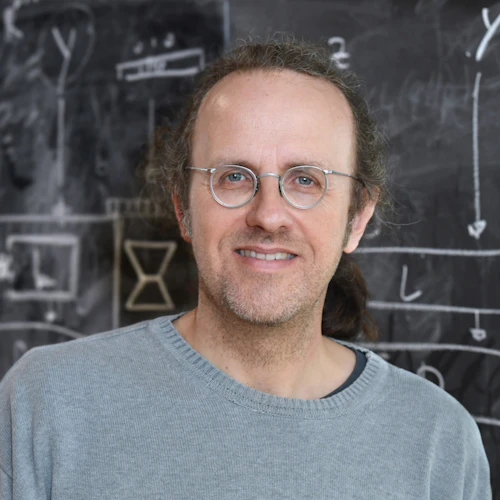
Scientific Director, ELLIS Institute Tübingen, Max Planck Institute for Intelligent Systems
Hard ProblemCapabilities
Bernhard Schölkopf
Bernhard Schölkopf studies machine learning and causal inference, with fundamental contributions to kernel methods, causality, and representation learning, applied to fields ranging from astronomy to robotics. Trained in physics and mathematics, he earned a Ph.D. in computer science in 1997 and joined the Max Planck Society in 2001. He is Scientific Director of the ELLIS Institute Tübingen and the Max Planck Institute for Intelligent Systems, and an affiliated professor at ETH Zurich.
His work has been recognized by international awards, including the ACM-AAAI Allen Newell Award, the BBVA Foundation Frontiers of Knowledge Award, the Gottfried Wilhelm Leibniz Prize, and the Royal Society Milner Award. He co-founded the ELLIS Society and helped establish the Journal of Machine Learning Research, an early open-access initiative that has become the field’s flagship journal.
AI2050 Project
Current AI systems excel by learning from human-generated data. Motivated by the notion of “thinking as acting in an imagined space” we ask how AI systems can instead learn by interacting with the world: observing, acting, experimenting, and updating internal models from the consequences. Schölkopf’s proposal develops causal world models, latent representations in which actions and interventions can be simulated and reasoned about. It combines causal representation learning, world models, and transformer-based causal inference. The goal is to build foundations for AI systems that generalize more robustly, reason about actions and interventions, and contribute to scientific discovery.
Scientific Director, ELLIS Institute Tübingen, Max Planck Institute for Intelligent Systems
Hard ProblemCapabilities